

How Many Ghost Shrimp To Clean 40 Gallon
Ghost shrimp (also known as Glass shrimp), are easy to intendance for, cheap, and entertaining to watch.
Making them a bully addition to most freshwater aquariums.
Often used a feeders, cleaners, or just for a bundle of fun, in this guide, I'll hash out everything you need to know about housing these critters.
The Overview: What Are Ghost Shrimp?
Ghost shrimp are dwarf freshwater shrimp native to the Southeastern United States. They're likewise chosen glass shrimp or grass shrimp.
In that location are several species sold nether the name ghost shrimp, but near in the aquarium trade are Palaemonetes paludosus.
They're bred as live food for larger aquarium fish or as an ornamental species for habitation aquariums.
What do Ghost Shrimp Look Like?
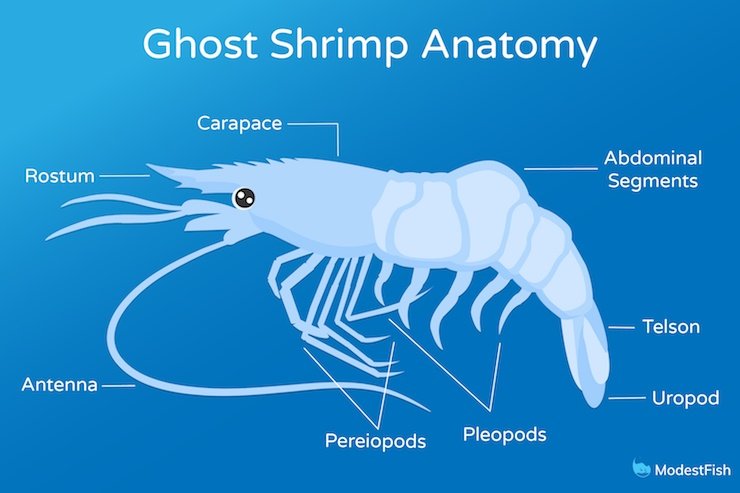
Ghost shrimp got their proper noun considering…well…they look like trivial transparent ghosts swimming around the tank.
This is going to sound weird, simply the name and the fashion they swim always makes me think of the little ghosts that chase you around in Pac-Man.
Their bodies are so clear that it can be really hard to see them against some backgrounds.
Which is kind of the signal. It makes them harder for predators to see them.
This is a good thing for the ghost shrimp. I'one thousand sure fish find ghost shrimp just equally tasty equally humans exercise their bigger Gulf shrimp cousins.
Allow's break down their different parts:
1. Antenna
Ghost shrimp take four antennae, one pair is longer than the other.
Just like other insects, fish and crustaceans, they use their antennae to navigate around objects, find food, communicate with each other and sense water conditions.
two. Body Segments
Ghost shrimp beefcake is very similar to other shrimp species.
Their bodies can exist divided into two main parts, the cephalothorax and the abdomen.
The cephalothorax is the large, front section of the body. And don't be intimidated by the discussion. All cephalothorax just means, "head chest."
The front end of the cephalothorax comes to a point, called the rostrum. This gives the caput the distinctive look you usually associate with shrimp, lobsters and crayfish.
An eyestalk comes off either side of the rostrum. Ghost shrimp can actually motion the eyestalks around and so they tin can see their surroundings without moving their bodies.
That manner, they can keep an middle on predators lurking effectually without moving and giving their positions away.
Backside the optics is the carapace, a big section of beat out that covers the rest of the cephalothorax.
Most of the shrimp'due south organs, like the heart, stomach and gills, are institute there.
The carapace is so transparent that y'all tin can really see food every bit it'due south eaten and moves through the digestive system.
Kind of gross, and yet, somehow fascinating.
On the lesser of the carapace are five pairs of walking legs, chosen periopods. Shrimp use these to walk along the bottom or climb on rocks and plants.
Two pairs of periopods too accept tiny claws, similar a lobster or crab, that the shrimp uses to put nutrient in its oral cavity.
The next segment is the abdomen. This section is generally taken up by the big muscles that work the tail. The reproductive organs and the intestine are also in this segment.
The belly is covered by seven overlapping plates of crush. The overlapping plates allow the abdomen to be flexible and then the shrimp can curlicue its tail.
Underneath the abdomen are v pairs of swimming legs, or pleopods, that the shrimp can use to scoot around in open water.
Female shrimp deport their eggs on the bottom of their abdomens and constantly fan them with the pleopods to requite them oxygen.
The last abdominal plate comes to a sharp signal, called a telson. Four pieces of shell chosen uropods fan out from either side of it, forming the tail.
Shrimp use their tails to evade predators. The tail curls rapidly and the shrimp tin can hurl itself backwards to go away.
three. Color Range
Ghost shrimp don't really have much of a color range. Their bodies are always almost completely clear.
If you look closely, they are covered with piffling dark speckles, some dark-green, others more brownish.
How Large Are Ghost Shrimp?
Ghost shrimp stay pretty darn small, adults are unremarkably simply one.5 inches long. The absolute biggest are ii inches long.
Females tend to be a bit bigger than males.
How Long Do Ghost Shrimp Live?
These little guys do not have a very long lifespan. They usually merely live for about a year.
If you buy ones that were meant for feeding large fish, they may not alive long at all.
Most are wild caught and take a rough fourth dimension in transport. Feeder animals are generally not handled and housed also equally animals meant to be pets.
It's a sad fact, but it's true.
If yous're buying feeder shrimp to keep and raise, it'southward a good idea to get a big group. That way, you lot hopefully get some tough plenty to survive and breed.
Ghost Shrimp Molting
All shrimp molt. Once their outer shell hardens, it can't actually get bigger.
As the rest of the shrimp grows, the shell becomes too small. They accept to shed this old one so a new, larger ane tin supercede information technology.
Most immature dwarf shrimp molt about weekly. Adults might go a month or more between molts. It all depends on how much they are feeding and growing.
It's difficult to tell how ofttimes individual ghost shrimp molt since they're usually kept in large groups.
So it'southward difficult to tell which ones have molted and which ones haven't.
Merely molting is e'er a proficient sign. It means your shrimp are healthy and growing.
The Molting Procedure
A twenty-four hours or ii before the molt, y'all might notice that the shrimp looks a little more opaque than usual.
This happens because the new layer of shell is forming underneath the old one.
When the big twenty-four hours arrives, the shrimp will whorl its tail under its trunk again and once more, trying to loosen the old shell.
Y'all might also meet the shrimp moving its legs a agglomeration, trying to loosen those upwards, too.
The crush will split where the tail meets the cephalothorax. The ghost shrimp volition ordinarily pull it'south front end half out of the old crush and then flick backwards really quick to get its tail costless.
Sometimes, they'll do this and then rapidly that you'll miss it completely.
Molted or Dead? How to Tell?
One thing well-nigh molting though, sometimes it can freak you out because the molted shell looks similar a expressionless shrimp in the tank.
And simply to add to your worry, you lot might count ghost shrimp and find that 1'southward missing.
That's because shrimp are really vulnerable later on a molt. Their new shell is soft for a few days. They do everything they can to hide themselves during this fourth dimension.
Luckily, it's easy to tell a molt from a dead shrimp.
A molted beat out even so looks clear, similar it's made of drinking glass. Sometimes, you see simply half of the beat out because the crush splits betwixt the cephalothorax and tail.
A dead ghost shrimp won't look clear anymore. Their torso turns a whitish pink color. It almost looks similar the shrimp has been cooked.
If you lot find a molted shell, it's fine to leave it in the tank. Shrimp volition ofttimes consume the old shell, which has minerals in information technology that are really good for them.
Ghost Shrimp Care & Tank Requirements
At present you know a flake more about Ghost shrimp, let's run through the steps needed to set upwards an aquarium.
What Tank Size is Best for Ghost Shrimp?
Since ghost shrimp are so tiny, they don't need a huge tank. You could keep a single shrimp in something every bit small equally a two gallon.
But if you're wanting to keep a group (which I would recommend), it's better to put them in a five gallon or larger.
Keep in listen, the bigger the tank, the easier it is to command your water quality.
Filtrations for Ghost Shrimp
Ghost shrimp are actually pretty tough, or they wouldn't be able to survive the conditions of being caught and so shipped all over the world.
So you don't need to go completely over the top with your filtration. You tin can just apply a filter that'due south rated to handle your size tank.
Ghost shrimp aren't crazy about a really stiff electric current in the water. They can accept a hard time swimming against it.
Then don't add a filter meant for a xl gallon on a little 10 gallon tank. The poor ghost shrimp would be plastered to the floor of the aquarium.
Hands downwards, the best kind of filter to take in a shrimp tank is a sponge filter. They don't create a lot of crazy flow and they're peachy mechanical and biological filters.
Plus, shrimp can't become stuck on/in them. You lot'll even see that the shrimp volition graze forth the sponge all the fourth dimension.
You can use a standard hang on the dorsum or canister filter if that's what you already have.
Just, shrimp can get sucked into filter intakes that are really powerful. Many, many people accept opened up their filter to clean it and found shrimp within, munching on filter gunk.
Yous can add a sponge pre-filter onto the intake of your existing filter that will go along shrimp (peculiarly babies!) prophylactic.
A Special Mention for Lids
It's best to have a tight-fitting lid that has as few gaps as possible.
Shrimp are really skilful jumpers and have been known to finish upwardly on the carpet.
So make certain to shut up any gaps in your lids every bit much as possible in case your shrimp decide to go on a walkabout.
Lighting your Ghost Shrimp Tank
Here'due south the thing about lighting and aquariums: it'southward more for usa than it is for the critters we proceed.
Fish and shrimp really don't accept "lighting requirements."
The lights are there so we can run across the tank, non considering our livestock has some kind of solar receptors.
If anything, a lot of species demand shady areas that they can retreat to. That helps them feel less stressed.
Ghost shrimp volition do fine under bright lights or dim ones. Merely requite them some petty hidey holes and then they can get away from the low-cal if they experience shy.
If y'all've got alive plants in the tank (which the shrimp volition LOVE), base your lighting on what the plants need. The shrimp will just hang out either way.
Plants and Decorations
Like I said before, shrimp similar lots of places to hibernate. Being in a bare tank can be really stressful for them. Especially when they're molting.
Brand sure to give them lots of options for hiding places. Rocks, fake plants, driftwood, decorations with little caves, yet you want to do it.
Ghost shrimp will really appreciate a heavily planted tank. This gives them lots of places to hide.
And they will happily munch on constitute textile as it breaks down.
Plus, live plants assist keep downwardly nitrates in the tank, so they make the surroundings healthier.
Substrate
Ghost shrimp don't actually require whatsoever kind of special substrate. Gravel, sand or planted aquarium substrate will be just fine.
Y'all should selection your substrate based off of the plants you option.
Simply, yous tin can see them better against a dark substrate.
A Special Mention: The Nitrogen Cycle
You want to make sure that you don't add together ghost shrimp unless your tank has been properly cycled.
If you're new to all this, maybe you think you simply add h2o and and then drib fish in.
Lamentable, merely it's a picayune more complicated than that.
As fish and shrimp eat, they put off waste.
All that pee and poop starts to interruption down in the tank and put off ammonia (NH3 ). This is bad news because ammonia can build upwards and chop-chop stress or kill fish/invertebrates.
Luckily, there are beneficial leaner that colonize a tank'due south filters and substrate. Ane kind turns ammonia into nitrite (NO2 -1), which is all the same really toxic. Simply so another kind takes nitrite and turns it into the much less toxic nitrate (NO3- ).
But the bacteria don't just show upward overnight. It can take weeks for the beneficial bacteria to move in and start doing business.
This can hateful that any critters in the tank are exposed to toxic ammonia and nitrite. This tin easily stress and kill fish and invertebrates.
Ghost shrimp aren't terribly delicate. They can adapt to all sorts of weather condition.
But at the aforementioned, that doesn't mean that they're going to do well in a tank while it's being cycled.
Make certain that your aquarium is fully cycled earlier adding ghost shrimp.
You can see our total guide on cycling your tank hither.
Pro Tip: Taking the fourth dimension to do a fishless wheel before you lot add livestock to a tank will give you better results. Patience volition pay off with good for you, happy fish.
Ideal Water Parameters for Ghost Shrimp
- Ammonia and Nitrite: 0
- Nitrate: <20 ppm
- Temp: 65°-75°F (xviii.3°-23.8°C) ghost shrimp can survive in temps as high equally 80°F, just higher temperatures can cause molting issues and an increased take a chance of bacterial infection.
- GH: 3-10 dGH (l-166.7 ppm)
- KH: 3-15 dKH (53.6-268 ppm)
- pH: 7.0-8.0
Pro Tip: Most shrimp experts don't fifty-fifty utilize heaters in their tanks. They just allow the h2o acclimate to the room temperature. Subtle temperature swings between twenty-four hour period and night actually mimic the shrimps' natural habitat.
Ghost shrimp can adapt to many dissimilar water conditions. But shrimp, and other invertebrates, demand a source of calcium in order to grade their shells.
Information technology'south important to maintain a good for you GH so the shrimp ever have a source of calcium to form their shells.
Pro Tip: If you lot accept soft water, yous tin can add minerals with a supplement like Seachem Equilibrium or Weco Wonder Shells. Offer calcium rich foods like blanched spinach is also a large aid.
Tank Mates for Ghost Shrimp
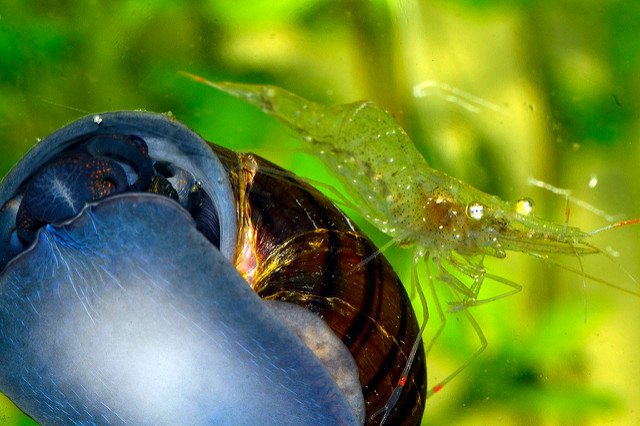
Here'south the matter, ghost shrimp are small and…tasty.
Fish accept a simple dominion when information technology comes to roommates: if he fits in my oral fissure, he must be nutrient.
Large, ambitious fish will definitely consume these guys.
Even smaller fish may harass a shrimp to decease past picking at it.
And you can't know for sure how it's going to become.
For instance, bettas are way likewise small-scale to consume an adult ghost shrimp in 1 go. But they might keep nipping at a ghost shrimp until information technology dies.
It's also been reported that assasin snails might kill and consume shrimp.
Species you might mix with ghost shrimp:
- Guppies
- Endlers
- Tetras
- Rosbaros
- Corydoras
- Otoclinus catfish
- Nerite snails
- Mystery snails
Just remember, even small fish tin exist a threat to larval ghost shrimp.
It's also non a practiced thought to mix ghost shrimp with other kinds of shrimp. They have been known to kill cerise cherry shrimp and other smaller species.
Ghost Shrimp Diet & Feeding
Ghost shrimp volition spend much of their day grazing on the algae and biofilm that grows in the tank.
Yous'll see them constantly walking around, sifting through the substrate.
It's a proficient idea to use a glass feeding dish for these guys. Shrimp are messy eaters. Putting their nutrient in a dish keeps little pieces from breaking off and sinking into the substrate.
Ghost shrimp tin be snappish with each other when it comes to food. It's ameliorate to use a larger feeding dish so less aggressive shrimp have room to eat.
What do Ghost Shrimp Eat?
Ghost shrimp are omnivores so they will eat just about anything. Some good foods include:
- Flake food
- Shrimp food pellets
- Globs of algae
- Blanched vegetables similar spinach, romaine, cucumber or zucchini
- Algae wafers
- Blood worms
- Leaves (Indian almond leaves are a favorite)
- Spirulina
Related Post: What Practise Freshwater Shrimp Eat?
How Often Should I Feed Ghost Shrimp
Because ghost shrimp constantly graze on stuff in the tank, you don't really accept to feed them a whole lot.
If you have fish in the tank, they'll happily consume any flake food that sinks to the bottom.
If you have a big colony of ghost shrimp, feeding every twenty-four hour period is OK. Only brand sure that the shrimp consume it all inside 4 hours and remove uneaten food.
If they're leaving a lot of food, give them less at a time. Or you can switch to feeding every other day.
If yous merely have a few shrimp, you lot probably only need to feed them iv times a week. Particularly in a heavily planted tank where they tin can graze all solar day.
You should always encounter the shrimp actively go after nutrient within ten minutes or so of information technology beingness dropped in the tank.
If they're non immediately going for it, they're not really hungry. Remove the food and requite them a day or two to get hungry.
Ghost Shrimp as Feeder Fish
Ghost shrimp do make a tasty treat for large fish, similar Oscars or Jack Dempseys.
But in that location'due south a catch.
They're really not that nutritious. Most ghost shrimp are wild caught and generally merely not treated very well.
Feeder fish are really only as nutritious as the diet they've been eating. And so if they've been jostled around from identify to place and fed a crummy diet, they're non that keen of a food source.
The good news is, you can change that by gut loading.
Gut Loading
Concord the shrimp for several weeks in a split tank and feed them a nutrient-rich diet. This can profoundly increment their value every bit a food for fish.
Since ghost shrimp will consume just about annihilation, give them food that has all the nutrients your fish need.
Afterward a few weeks of fattening them up, drop them in the tank and watch your fish go to town.
I always enjoy watching my fish go after live foods. They just get and so excited about it.
Concerns About Parasites
You might exist worried about your fish picking upwards parasites from live foods. This is a legitimate business, especially if you feed things similar feeder goldfish or minnows.
Ghost shrimp tin can carry nematodes in their guts.
But the practiced news is that the nematodes that infect ghost shrimp do not appear to exist able to touch fish.
In that location are parasitic nematodes (Camallanus) that can infect fish. Simply they utilize copepods, tiny crustaceans, as their intermediate hosts. Non shrimp.
How to Breed Ghost Shrimp
Breeding ghost shrimp can exist tricky. When they hatch from their eggs, they are free-pond larvae that are very vulnerable to fish and other shrimp.
It's all-time to have a separate breeding tank. The breeding tank doesn't need to be fancy, a simple sponge filter is great. The sponge filter won't suck up any tiny shrimp larvae.
If you can swing it, live plants in the convenance tank are not bad because they provide a food source for larval shrimp. But they're not absolutely necessary.
Female ghost shrimp will develop a green "saddle" on the underside of their tails. This is a cluster of eggs that the female will constantly fan with her swimming legs.
The term for a female carrying eggs is "berried" since the little eggs look similar little round fruit.
They've e'er looked more than similar grapes to me, but I wasn't consulted when the hobby decided on the term.
Berried females put out pheromones that permit the males know they're fix. Males will zoom around until they find her and fertilize her eggs.
A few days afterwards y'all come across the female become berried, remove her from the main tank. Continue her in the breeding tank until the eggs hatch, usually a month.
Y'all can tell the eggs have hatched considering they'll no longer exist amassed nether her abdomen.
Then take the female person out of the convenance tank and put her back in the primary tank. That mode she won't eat the babies.
Shrimp larvae can exist fed finely powdered spirulina or infusoria.
Pro Tip: You tin can culture your own infusoria. Information technology'southward really simple and a fun science projection to do with kids. You can picket a video hither.
Shrimp larvae volition metamorphosize into tiny shrimplets later well-nigh a week. They can then be fed just like developed shrimp. Be careful not to overfeed.
After five weeks or then, shrimplets should be big enough to put in the main tank.
Final Thoughts On Ghost Shrimp Care
Ghost shrimp really are interesting creatures. I beloved their encounter-through bodies and nonstop antics.
They're active, constantly skimming the substrate or grazing along plants and driftwood. There'south always something to scout with them in the aquarium.
They make a great improver to the cleaning crew in your tank or tin can even star as the main attraction.
Yous don't need a huge tank or an elaborate setup to enjoy these guys. A 5 gallon with a simple sponge filter volition do the play a trick on.
Raising ghost shrimp is a not bad manner to always have live foods on hand for predatory fish.
With a fiddling effort, and the right setup, these guys can breed like crazy. And then you can have a constant supply of yummy treats for your large fish.
Whether for pets or feeders, or both, I highly recommend these crazy little critters.
Related Posts:
- Ruby-red Ruby Shrimp: Aquarist's Care & Anatomy Guide
- Aquarist'south Guide To Amano Shrimp: Care, Lifespan, Feeding, And Tank Mates
- The 16 Best Freshwater Algae Eaters (Clean-Up Crew) To Command Algae Growth
- thirteen Best And Worst Types Of Bottom Feeder Fish For Your Aquarium

Source: https://modestfish.com/ghost-shrimp/
Posted by: talleygatited.blogspot.com
0 Response to "How Many Ghost Shrimp To Clean 40 Gallon"
Post a Comment